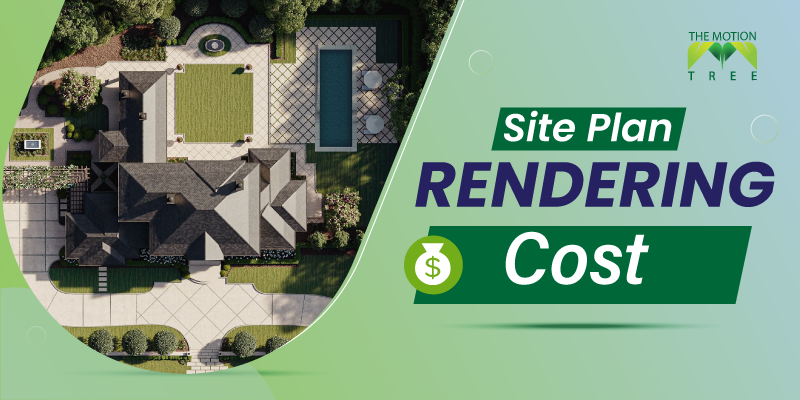
If you’re planning a residential community, a commercial development, or even a landscape masterplan, chances are you’ll need a site plan rendering at some point. These visuals bring your ideas to life, showing the layout of roads, buildings, landscaping, and amenities in a way that CAD drawings simply can’t.
But one of the first questions most architects, developers, and real estate marketers ask is: “How much does a site plan rendering cost?”
The short answer is:
The long answer is that pricing depends on several factors, from project scale and level of detail to deadlines and the provider you choose. Today, I will break down the numbers, explain what drives costs, and show you how to budget smartly without compromising quality.
On average, an architectural rendering today ranges between $300 and $3,000. The wide range depends on the project’s scope, the level of detail required, and the type of deliverables.
For example, a simple schematic aerial view used internally for massing reviews might cost just a few hundred dollars.
In contrast, a polished, photorealistic rendering designed to impress investors or appear in brochures can run into the thousands. More advanced options, such as interactive 360° panoramas or animated flyovers, can push the price even higher, sometimes exceeding $10,000 for large commercial projects.
If the rendering is primarily for early-stage design discussions, you can save money by opting for lower levels of detail. But if your goal is to market properties or secure funding, the investment in higher-quality visuals is usually worth it.
One of the most common frustrations for clients is seeing such a wide range of pricing across different rendering firms. Why does one studio quote $600 while another quotes $2,000 for what seems like the same deliverable? The answer lies in the variables behind the work.
The larger and more intricate your site, the more hours of modeling and rendering it requires. A small residential subdivision with 10 houses is vastly different from a 50-acre mixed-use complex with retail, residential towers, green spaces, and detailed infrastructure. More buildings mean more geometry, and larger terrains mean more textures and landscaping to get right.
A simple schematic rendering may show just massing, roads, and green patches. A high-end photorealistic rendering, on the other hand, includes detailed paving materials, reflections, realistic shadows, cars in parking lots, and people walking along sidewalks. Achieving this realism requires more powerful hardware, longer render times, and highly skilled artists. The difference in effort can easily double or triple the cost.
Most studios price per image. If you need one aerial view, you’ll pay less than if you need five different angles covering every corner of the site. Similarly, an animation is essentially thousands of frames rendered in sequence, which explains why video renderings are significantly more expensive than stills.
Rushed deadlines almost always come at a premium. If you request delivery in three days for what would normally take a week, studios need to allocate extra resources, run overnight rendering, or put other projects on hold. Expect to pay anywhere from 20% to 50% more for expedited service.
Do you already have CAD files, a BIM model, or a detailed site survey? Providing these drastically reduces the time needed for modeling. On the other hand, if the studio has to reconstruct everything from scratch based on rough sketches, the price will climb.
Just as architects with strong portfolios charge more, rendering studios with established reputations and high-end case studies can command premium pricing. Location also plays a role: a US-based provider may charge $1,500 for a render that a studio in Eastern Europe or South Asia can produce for $600–$800. Quality may be comparable, but communication and project management styles can differ.
To put numbers into perspective, let’s look at common scenarios. A basic schematic 3D site plan, where the focus is on layout and scale rather than photorealism, usually falls in the $300 to $800 range. If you need a more detailed and polished rendering, with landscaping, entourage, and post-production finishes, expect to pay between $800 and $2,000 for a single image. When projects require multiple images from different perspectives, the package price often lands between $1,500 and $4,000.
For clients who want interactive experiences, such as a 360-degree panorama or a walk-through model, costs generally start around $800 and can exceed $2,500 depending on complexity. Animated flyovers, which are the most resource-intensive, begin at about $2,500 and can easily go beyond $10,000 for cinematic-quality production.
Most rendering providers base their pricing on one of three models. Some charge per image, making it easy to compare costs if you only need a single still. Others create bundled packages that include several images and revisions, often at a lower overall rate.
For more open-ended or experimental projects, studios may charge by the hour. Rates vary widely depending on location and experience level, but it’s common to see anything from $20 per hour for offshore freelancers to $150 or more for senior artists at established firms.
The Motion Tree, for example, often combines these models. Clients can choose between affordable per-image rates for simple work, or they can opt for packages that scale with the complexity of the project. This flexibility ensures that budgets remain predictable while quality stays consistent.
The good news is that you can take several steps to reduce site plan rendering costs without compromising too much on quality. One of the most effective strategies is to provide as much source material as possible. CAD drawings, BIM models, and site surveys significantly cut down the modeling workload, which saves both time and money.
Another approach is to start small. Early in the project, you may only need a schematic rendering to explore ideas or share with stakeholders. Once the design matures, you can then invest in higher-detail marketing visuals. Bundling multiple deliverables together also tends to be more cost-effective than ordering images one at a time.
Limiting revisions can also help. Every new round of changes adds labor hours. By locking down major decisions early, you can keep your costs under control. And finally, choosing the right provider for the right stage of your project matters. A freelancer may be perfectly suitable for a quick schematic rendering, but if you need polished visuals for an investor deck, a studio with a proven process like The Motion Tree is usually the better investment.
At The Motion Tree, site plan rendering projects are managed in three clear phases.
First, the team focuses on data intake. By collecting CAD drawings, topography, and references upfront, they reduce modeling time and prevent errors.
Next comes a schematic proof, a quick and affordable draft that confirms massing, landscaping, and camera angles. This avoids costly last-minute revisions. Finally, the rendering is refined into a polished, marketing-ready image or interactive model, complete with materials, lighting, and post-production enhancements.
This phased approach is designed to give clients flexibility. Some only need the schematic stage, while others go all the way to photoreal output. By offering scalable options, The Motion Tree ensures clients never pay for more detail than they actually need.
For a standard site plan rendering, most projects take between three and ten business days. That timeline depends on how much modeling is required and how many revisions are requested. Animations, which involve additional steps like storyboarding and camera work, usually require several weeks. If you’re facing a hard deadline, studios can often expedite delivery, but rush jobs almost always come at a higher price.
When reviewing quotes from different providers, look for transparency. A professional studio should clearly separate the cost of modeling, rendering, and revisions. They should specify how many images are included, at what resolution, and how many rounds of feedback you’re entitled to.
Asking for portfolio samples of similar site plans is also a smart move, since it shows you what level of detail to expect for the quoted price. The real trick to controlling cost is aligning the rendering quality with your goals. If the visuals are intended for internal approvals, don’t overspend on photoreal details. If they’re for marketing or investor presentations, invest in higher quality from the start.
Understanding site plan rendering cost is about more than just knowing the price tag. It’s about knowing what factors drive those costs, what you actually need for your project’s stage, and how to make smart decisions that balance budget with impact. Prices are still varying widely, but with the right provider and clear communication, you can secure renderings that are both affordable and effective.
The Motion Tree specializes in delivering exactly that balance. With flexible packages and a scalable process, they provide cost-effective solutions without sacrificing the quality that makes site plans stand out. Whether you need a quick schematic rendering or a polished marketing asset, their team can guide you toward the right option for your budget.
1
2
3
April 7, 2026
6
April 3, 2026
7
April 3, 2026
8
10
April 3, 2026