Over the last decade, 3D rendering and modeling have quietly shifted from a “nice visual upgrade” to a core business tool. Brands that once relied only on photography now use 3D assets to launch products faster, localize campaigns, test ideas, and scale content without friction.
But here’s something the market has learned the hard way: Hiring a studio for one-off 3D projects rarely works long term. As product catalogs grow and marketing channels multiply, what brands really need is a 3D rendering and modeling partnership, not just a service provider. A partnership creates consistency, speed, and reliability across every visual touchpoint.
This is where experienced studios like Motiontree operate best, not as short-term vendors, but as long-term production partners embedded into a brand’s workflow.
Anyone who has worked on multiple 3D projects knows the pattern. Each project starts with re-explaining the product. Each artist interprets realism differently. Lighting, scale, and materials change subtly every time.
These small inconsistencies add up, especially for brands selling online or across multiple platforms. A 3D rendering and modeling partnership solves this by building continuity over time. The studio learns the product inside out. Assets become reusable. Visual standards are established. Production becomes predictable.
From an operational standpoint, this shift mirrors what happened in design, development, and marketing retainers. Brands no longer want to start from zero every time. They want a system that scales.
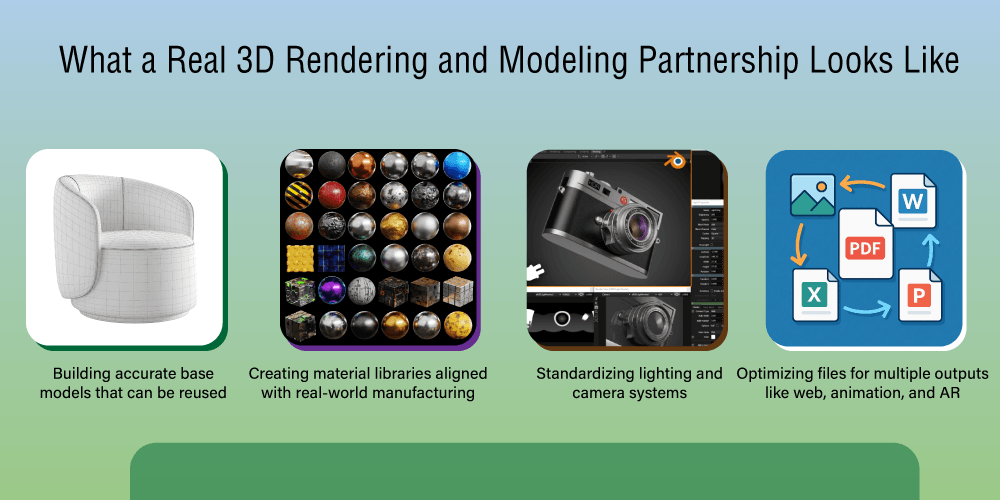
In practice, a partnership goes far beyond delivering finished renders. It involves:
Studios that work this way tend to feel less like external suppliers and more like an extension of the internal creative team. The Motiontree follows this approach closely, which is why their partnerships tend to last across multiple product cycles rather than single campaigns.
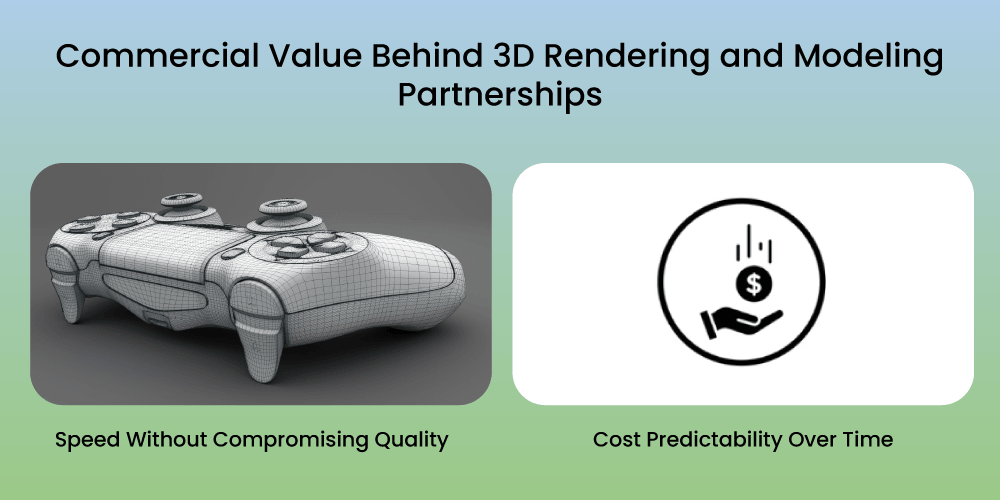
Commercially, a perfect 3d rendering and modeling partnership can take you one step ahead of your competitors.
Speed matters, but speed without structure usually leads to sloppy output. A partnership creates speed through familiarity, not shortcuts. Once a studio understands your product line, new SKUs can be visualized quickly without sacrificing accuracy. This is especially valuable for brands that launch frequently or update designs often. In real-world scenarios, this can shave weeks off launch timelines.
From experience, project-based 3D work often looks affordable at first, then becomes expensive through revisions, inconsistencies, and rework. Partnerships stabilize costs. Reusable assets reduce modeling time. Established workflows reduce revision cycles. Over time, the cost per asset drops while quality improves. This is one reason mature brands increasingly prefer long-term 3D collaborators over rotating freelancers.
So does this partnership actually matter in real life business? Yes, marketing with 3d visuals can impact any business.
For eCommerce, volume and consistency matter more than cinematic perfection. Partnership-based 3D workflows allow brands to:
This is particularly valuable when managing hundreds or thousands of SKUs.
In many industries, marketing now starts before physical production. A reliable 3D partner allows brands to create launch visuals, pitch decks, and promotional materials while products are still in development. This reduces risk and accelerates revenue timelines. This approach has become standard in consumer electronics, furniture, and hardware startups.
High-quality animation is impossible without clean, well-structured 3D models. When modeling is done with animation in mind from day one, brands avoid costly rebuilds later. A long-term partner understands this and prepares assets accordingly. This is one area where experience truly shows.
Many studios can produce good-looking renders. Fewer understand how visuals are actually used across marketing funnels. Experienced 3D partners think about:
Motiontree operates with this production mindset, which is why their work integrates smoothly into real marketing systems, not just portfolios.
One of the most overlooked benefits of a 3D rendering and modeling partnership is communication efficiency. Over time:
The studio begins anticipating needs instead of reacting to instructions. This is only possible when there is continuity. In fast-moving marketing environments, this level of understanding saves more time than any technical shortcut.
3D assets are no longer limited to static images. Today’s models are reused for:
Brands that invest in partnership-driven 3D production are effectively future-proofing their content.
Studios that understand this, including Motiontree, design models that are flexible enough to adapt as platforms evolve.
From industry experience, brands stay loyal to 3D partners for three main reasons:
A strong partnership removes friction from creative production, which is often one of the biggest bottlenecks in growing businesses.
Here are 5 natural, reader-intent FAQs that someone would realistically ask after reading the article.
They are curiosity-driven, trust-building, and still SEO-friendly without sounding forced.
If your business regularly needs product visuals, launches new SKUs, or updates marketing content across multiple platforms, a partnership makes sense. When 3D work becomes recurring instead of occasional, a long-term setup saves time, cost, and effort compared to managing separate projects.
Onboarding usually starts with understanding your products, brand guidelines, and use cases. This is followed by test renders to align on quality and style. Once approved, workflows are finalized so future projects move faster with minimal back-and-forth.
Yes. A good partnership improves creative control rather than limiting it. You set the direction and brand standards, while the 3D team executes within those boundaries. Over time, the partner anticipates your preferences, making collaboration smoother.
When built properly, yes. High-quality 3D models can be reused for static renders, animations, interactive views, and even AR experiences. This is one of the biggest advantages of working within a partnership instead of isolated projects.
After the initial setup, turnaround times are significantly faster. Since the models, materials, and visual standards are already in place, new renders or variations can often be produced in days instead of weeks.
A 3D rendering and modeling partnership is not just a production decision. It is a strategic one.
Brands that treat 3D as a long-term system, rather than a series of isolated tasks, move faster, look more consistent, and spend more efficiently.
Studios like The Motiontree have built their reputation by working this way, focusing on durable partnerships instead of transactional work. In a market where visuals increasingly define brand credibility, choosing the right 3D partner is less about who can render something once and more about who can support your growth for years.
2
3
4
April 7, 2026
7
April 3, 2026
8
April 3, 2026
9